
Many users compare Bitcoin and Solana when deciding which asset fits their goals. Those starting with Solana often look for straightforward acquisition methods; guides that explain how to buy sol with credit card clarify payment steps, fees, and wallet transfers.
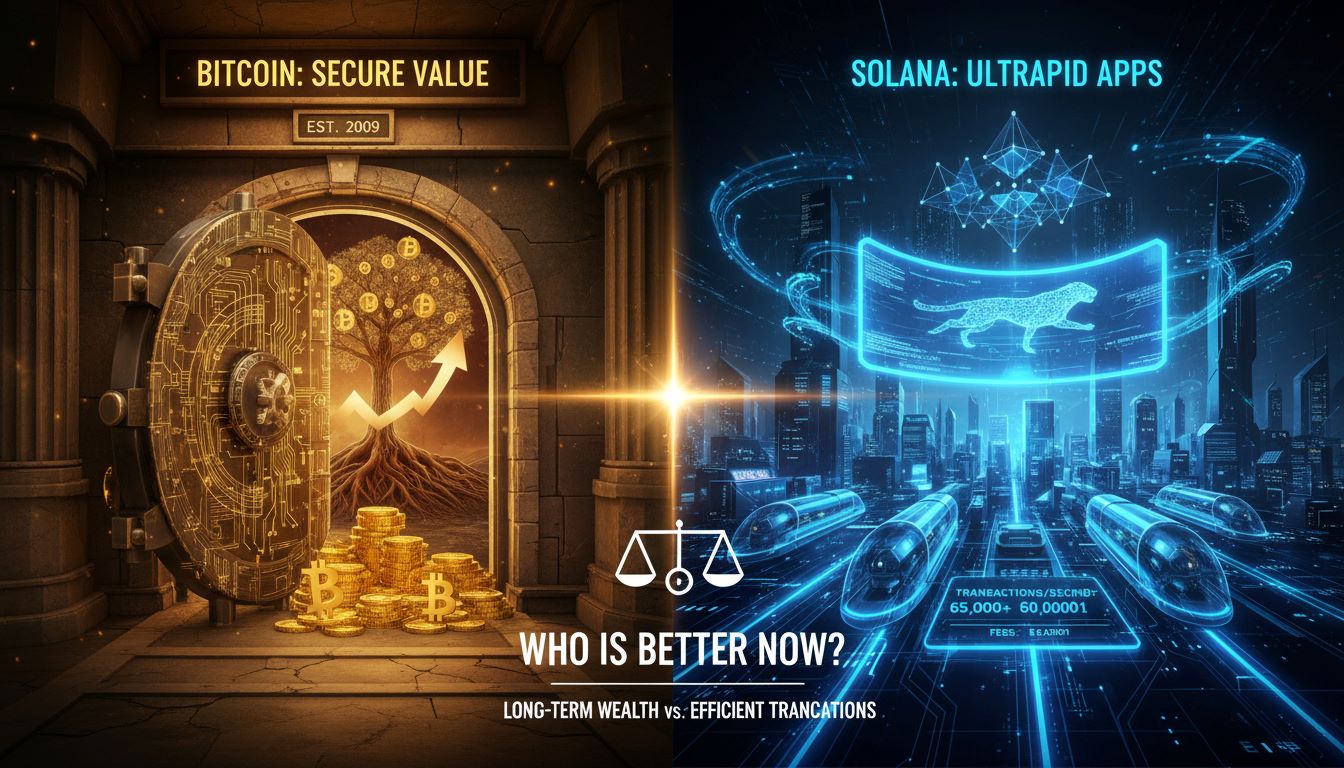
Bitcoin represents the original digital currency, focused on security and its role as a long-term store of value, while Solana has emerged as a high-performance platform optimised for speed and applications. Understanding these fundamentals helps users decide what belongs in their portfolio and why. For instance, someone adding Bitcoin might care more about long-term preservation, whereas someone choosing Solana might prioritise transaction speed or access to emerging applications such as DeFi platforms and on-chain tools.
This comparison provides an objective analysis of both networks’ strengths and trade-offs. Bitcoin offers unmatched security, longevity, and proven store-of-value properties. Solana delivers innovative technology, lightning-fast transactions, and minimal fees. The better choice ultimately depends on your specific use case—whether you prioritise long-term wealth preservation, need an efficient transaction network, or want to build on a cutting-edge application platform.
Bitcoin and Solana at a Glance
Understanding the fundamental characteristics of Bitcoin and Solana requires examining their core specifications and market positioning. These networks represent two distinct approaches to blockchain technology, each optimized for different priorities and use cases.
| Category | Bitcoin (BTC) | Solana (SOL) |
|---|---|---|
| Primary Purpose | Store of value, long-term preservation | High-performance network for apps and fast transactions |
| Consensus Mechanism | Proof of Work (PoW) | Proof of History (PoH) + Proof of Stake (PoS) |
| Transaction Speed | ~7 transactions per second | Up to thousands of transactions per second |
| Fees | Higher and variable | Very low |
| Network Strength | Most secure and decentralised | Highly scalable and application-focused |
| Ideal Use Case | Long-term holding, value stability | Fast payments, DeFi, NFTs, and on-chain tools |
| User Profile | Investors seeking resilience and security | Users prioritising speed, low cost, and modern applications |
This comparison reveals the stark differences between these networks. Bitcoin’s 15-year track record establishes it as the most trusted cryptocurrency, while Solana’s recent emergence showcases cutting-edge blockchain innovation. The dramatic difference in transaction throughput and fees highlights their respective design priorities.
These quick facts provide essential context for understanding each network’s positioning in the broader cryptocurrency ecosystem. Bitcoin’s conservative approach prioritizes security and decentralization, while Solana pushes the boundaries of blockchain performance and scalability.
History & Development
Bitcoin emerged in 2009 as the world’s first cryptocurrency, created by the pseudonymous Satoshi Nakamoto in response to the 2008 financial crisis. Its development has been deliberately conservative, with changes implemented slowly through community consensus to maintain network stability and security. Bitcoin’s protocol has remained largely unchanged since its inception, prioritizing proven reliability over rapid innovation.
Solana launched in 2020, founded by Anatoly Yakovenko, a former Qualcomm engineer who brought telecommunications expertise to blockchain design. The project raised significant venture capital funding and experienced explosive growth during the 2021 crypto bull market, quickly establishing itself among the top blockchain platforms.
The timeline difference reflects their distinct approaches: Bitcoin represents the mature, battle-tested foundation of cryptocurrency, while Solana embodies the ambitious next-generation vision of what blockchains can achieve with modern technology and aggressive optimization.
Core Philosophy & Vision
Bitcoin’s philosophy centers on digital scarcity and monetary sovereignty, positioning itself as “digital gold” for the internet age. The network prioritizes security, censorship resistance, and store-of-value properties above all else, accepting limitations in speed and functionality to maintain these core principles.
Solana’s vision focuses on mainstream blockchain adoption through superior performance and user experience. The platform aims to make blockchain interactions as fast and affordable as traditional web applications, enabling complex decentralized applications, NFT marketplaces, and high-frequency DeFi protocols that would be impractical on slower networks.
Technical Architecture & Consensus Mechanisms
The fundamental technical differences between Bitcoin and Solana stem from their consensus mechanisms and architectural choices. Bitcoin’s Proof of Work system has operated continuously for over 15 years, while Solana’s innovative Proof of History combined with Proof of Stake represents a newer approach to blockchain consensus.
| Feature | Bitcoin (PoW) | Solana (PoH + PoS) |
|---|---|---|
| Energy Consumption | High (~150 TWh annually) | Low (~1.9 GWh annually) |
| Validator Requirements | Specialized mining hardware | High-performance servers, 32 SOL stake |
| Block Time | 10 minutes | 400 milliseconds |
| Finality | ~60 minutes (6 confirmations) | ~13 seconds |
| Geographic Distribution | Global mining pools | ~1,900 validators worldwide |
Bitcoin’s Proof of Work requires miners to solve computationally intensive puzzles, creating an energy-intensive but highly secure network. This mechanism has proven its resilience through numerous attacks and market cycles, establishing unparalleled trust in the cryptocurrency ecosystem.
Solana’s Proof of History creates a cryptographic timestamp for transactions, allowing validators to process them in parallel rather than sequentially. This innovation, combined with Proof of Stake consensus, enables the network’s exceptional throughput while maintaining energy efficiency.
The architectural differences reflect each network’s priorities: Bitcoin optimizes for security and decentralization at the cost of speed, while Solana prioritizes performance and efficiency, accepting some centralization trade-offs.
Impact on Security, Decentralization & Scalability
Bitcoin’s security model relies on computational work and economic incentives, making attacks extremely expensive and impractical. The network’s hash rate has grown exponentially over time, now requiring nation-state level resources to mount a successful 51% attack. This security comes at the cost of scalability, with the network processing only 7 transactions per second.
Solana achieves higher throughput by requiring validators to meet stringent hardware requirements, effectively limiting participation to well-funded operators. This creates efficiency gains but concentrates network control among fewer participants. The network has experienced several outages during periods of high congestion, raising questions about its reliability under extreme conditions.
The fundamental trade-off between the blockchain trilemma elements—security, decentralization, and scalability—manifests clearly in these networks. Bitcoin maximizes security and decentralization while sacrificing scalability, whereas Solana optimizes for scalability and efficiency while making compromises on decentralization.
Both approaches have merit depending on use case requirements. Bitcoin’s conservative approach suits store-of-value applications and high-security transactions, while Solana’s performance focus enables complex applications and micro-transactions that require fast, cheap execution.
Transaction Speed, Fees & Network Efficiency
The user experience on Bitcoin and Solana differs dramatically due to their contrasting approaches to transaction processing. These differences impact everything from daily payments to complex DeFi interactions, making network efficiency a crucial factor for user adoption and practical utility.
| Metric | Bitcoin | Solana |
|---|---|---|
| Maximum TPS | 7 | 65,000+ |
| Average Confirmation Time | 10 minutes | 400ms |
| Typical Transaction Fee | $1-50+ | $0.00025 |
| Peak Congestion Fees | $50-100+ | $0.01-0.10 |
| Smart Contract Execution | Limited (simple scripts) | Full Turing-complete |
Bitcoin’s transaction fees fluctuate based on network demand, often becoming prohibitively expensive during bull markets when demand peaks. Users frequently wait hours for confirmation during congested periods, making Bitcoin impractical for time-sensitive or small-value transactions.
Solana’s sub-penny fees and near-instant confirmation enable use cases impossible on Bitcoin, such as high-frequency trading, gaming applications, and micropayments. This efficiency advantage has made Solana popular among developers building consumer-facing applications that require seamless user experiences.
Volume Handling: Scalability in Practice
During network congestion, Bitcoin experiences fee escalation and transaction backlogs that can persist for days. The 2017 crypto boom saw average fees exceed $50, making small transactions economically unfeasible. Users must carefully time transactions and pay premium fees for faster processing during high-demand periods.
Solana has faced different scalability challenges, including several network outages during periods of extreme demand. Notable outages in 2021 and 2022 saw the network halt for hours, requiring validator coordination to restart. While fees remain low during congestion, the network’s reliability becomes questionable under sustained high-volume conditions.
Network Upgrades & Scalability Solutions
- Bitcoin Lightning Network enables instant, low-cost payments through off-chain channels, though adoption remains limited due to complexity
- Taproot upgrade improved Bitcoin’s privacy and smart contract capabilities while maintaining network security principles
- Solana’s Firedancer client implementation promises improved performance and network stability through validator software diversity
- Turbine block propagation and Gulf Stream transaction forwarding optimize Solana’s throughput capabilities
- QUIC implementation reduces network latency and improves validator communication efficiency on Solana
Tokenomics & Supply Dynamics
The economic models governing Bitcoin and Solana reflect their different purposes and design philosophies. Bitcoin implements a deflationary model with capped supply, while Solana uses an inflationary system with staking rewards and potential burn mechanisms to balance supply dynamics.
| Tokenomics Aspect | Bitcoin | Solana |
|---|---|---|
| Maximum Supply | 21 million BTC (hard cap) | No hard cap (inflationary) |
| Current Inflation Rate | ~1.8% (decreasing) | ~5-8% (variable) |
| Staking Rewards | Not applicable | 6-8% APY |
| Reward Mechanism | Block rewards + transaction fees | New token issuance + fees |
| Token Distribution | Fair launch (mining only) | Team/investors (60%), public (40%) |
Bitcoin’s halving events every four years reduce new supply issuance, creating scarcity that historically drives price appreciation. This deflationary mechanism positions Bitcoin as a hedge against traditional monetary inflation, appealing to long-term holders seeking wealth preservation.
Solana’s inflationary model funds network security through staking rewards while encouraging participation in network governance and validation. The protocol includes mechanisms to adjust inflation rates based on network participation and could implement fee burning to balance supply growth.
Long-Term Value Implications
Bitcoin’s scarcity model creates predictable supply constraints that support its store-of-value narrative. As mining rewards decrease over time, transaction fees must eventually sustain network security, potentially creating upward pressure on fees but reinforcing the asset’s deflationary properties.
Solana’s value proposition depends on network usage and utility rather than scarcity alone. High transaction volumes and ecosystem growth drive demand for SOL tokens, while staking provides yield opportunities for holders. The success of this model relies on sustained network adoption and the ability to maintain competitive advantages in speed and cost-efficiency.
Market Performance & Volatility in 2021–2025
The market performance of Bitcoin and Solana during the recent crypto cycle reveals distinct patterns reflecting their different maturity levels and market positioning. Bitcoin’s established status provides relative stability, while Solana’s emergence coincided with explosive growth followed by significant volatility.
Bitcoin reached its all-time high above $69,000 in November 2021, followed by a prolonged bear market that saw prices drop below $16,000 in late 2022. The 2024-2025 period brought renewed institutional interest and potential ETF approvals, driving Bitcoin toward new highs above $100,000.
| Performance Metric | Bitcoin | Solana |
|---|---|---|
| Peak Price (2021) | $69,000 | $260 |
| Bear Market Low (2022) | $15,500 | $8 |
| Maximum Drawdown | 77% | 97% |
| 2025 Recovery High | $100,000+ | $250+ |
| Annualized Volatility | 60-80% | 90-120% |
| Correlation to BTC | N/A | 0.6-0.8 |
Solana’s price trajectory has been more dramatic, rising from under $2 in early 2021 to over $260 by November, representing a 130x gain in less than a year. However, the subsequent bear market was equally severe, with SOL falling over 95% from its peak, demonstrating the extreme volatility characteristic of newer, smaller-cap cryptocurrencies.
Volatility & Correlation Trends
Solana exhibits significantly higher volatility than Bitcoin, with daily price swings often exceeding 10-20% during active market periods. This elevated volatility reflects its smaller market capitalization, lower liquidity, and sensitivity to ecosystem-specific news and developments.
The correlation between SOL and BTC has varied between 0.6-0.8 during most periods, indicating that while Solana often moves in the same direction as Bitcoin, it amplifies both upward and downward movements. During periods of extreme market stress or Solana-specific events, this correlation can break down entirely, with SOL experiencing independent price action based on network-specific factors.
Major Bull and Bear Events
- FTX collapse (November 2022) – Solana’s close association with Sam Bankman-Fried led to severe selling pressure, while Bitcoin remained relatively isolated from the exchange-specific contagion
- Network outages (2021-2022) – Multiple Solana network halts during high congestion periods caused confidence crises and significant price declines
- Institutional adoption waves – Bitcoin ETF approvals and corporate treasury allocations drove sustained price appreciation independent of broader crypto market movements
- NFT boom on Solana (2021) – The emergence of successful NFT projects like Solana Monkey Business drove ecosystem growth and token demand
- DeFi summer expansion – Solana’s low fees enabled new DeFi protocols and yield farming opportunities, attracting users from Ethereum and driving network growth
Usage & Ecosystem: What Can You Do With Bitcoin vs Solana?
The practical applications and ecosystem development on Bitcoin and Solana reflect their different design priorities and technical capabilities. Bitcoin’s conservative architecture limits functionality but ensures security, while Solana’s performance optimization enables complex applications and diverse use cases.
| Use Case | Bitcoin | Solana |
|---|---|---|
| Store of Value | Excellent – digital gold | Moderate – higher volatility |
| Daily Payments | Poor – high fees, slow | Excellent – instant, cheap |
| DeFi Applications | Limited – wrapped BTC only | Extensive – full ecosystem |
| NFT Marketplaces | Emerging – Bitcoin Ordinals | Mature – Magic Eden, others |
| Gaming & Apps | Minimal – too slow/expensive | Growing – real-time capable |
| Developer Tools | Basic – simple scripting | Advanced – full programming |
| Institutional Adoption | High – treasury asset | Growing – tech partnerships |
Bitcoin’s primary strength lies in its role as a store of value and hedge against traditional financial systems. Major corporations like MicroStrategy and Tesla have added Bitcoin to their treasury reserves, while countries like El Salvador have adopted it as legal tender. However, Bitcoin’s utility for complex applications remains limited by its design constraints.
Solana’s ecosystem spans DeFi protocols, NFT marketplaces, gaming applications, and Web3 infrastructure. The network hosts over 400 projects across various categories, from decentralized exchanges like Jupiter to popular NFT collections and play-to-earn games that benefit from low transaction costs.
NFTs, DeFi & GameFi: Where Each Shines
- Solana DeFi ecosystem includes Serum DEX, Raydium automated market maker, Marinade staking protocol, and Mango Markets derivatives platform
- Major Solana NFT projects like Okay Bears, DeGods, and Magic Eden marketplace demonstrate the network’s capability for high-volume digital collectibles trading
- Bitcoin Ordinals emerged in 2023, enabling NFT-like inscriptions directly on Bitcoin, though limited by network constraints and high fees
- Solana gaming projects like Star Atlas and Aurory showcase blockchain gaming possibilities with real-time interactions and complex in-game economies
- DeFi on Bitcoin remains limited to wrapped tokens and simple protocols, with most innovation happening on sidechains or Layer 2 solutions
- Solana’s mobile initiative with Saga phones and dApp store represents ambitious Web3 mainstream adoption efforts
Security, Outages & Network Reliability
- Bitcoin’s hash rate exceeds 400 EH/s, making it the most computationally secure network in cryptocurrency history
- Bitcoin has maintained 99.98% uptime since launch, with no network-wide outages or successful 51% attacks
- Solana has experienced multiple network halts, with the most significant lasting 18+ hours in September 2021
- Bitcoin’s distributed mining infrastructure spans globally, reducing single points of failure and censorship risks
- Solana’s validator requirements concentrate network control among well-funded operators with high-performance hardware
- Bitcoin’s conservative upgrade process ensures stability but limits innovation and adaptation speed
Bitcoin’s security model has been tested through numerous market cycles, network attacks, and geopolitical pressures without suffering a successful breach. The network’s resilience stems from its decentralized mining infrastructure and economic incentives that make attacks prohibitively expensive.
Solana’s reliability challenges stem from its aggressive performance optimization, which can create bottlenecks during extreme demand periods. The network’s complexity increases the potential for bugs and coordination failures among validators, though recent upgrades have improved stability.
Notable Incidents & Response
- September 2021 – Solana network halt for 17 hours due to transaction flooding from bot activity, requiring validator coordination to restart
- May 2022 – 7-hour Solana outage caused by NFT minting bot spam overwhelming the network during Otherdeeds launch
- January 2022 – 4-hour Solana downtime from duplicate transactions creating consensus issues among validators
- June 2022 – Solana mobile wallet exploit draining funds from thousands of wallets, later attributed to Slope wallet compromise
- Multiple 2021-2022 – Shorter Solana partial outages lasting 1-6 hours during periods of high congestion or bot activity
Validator & Miner Distribution
Bitcoin’s mining is distributed among thousands of individual miners and mining pools across multiple continents, though concerns exist about geographic concentration in regions with cheap electricity. The Nakamoto Coefficient for Bitcoin mining pools suggests reasonable decentralization, though pool concentration requires monitoring.
Solana operates approximately 1,900 validators globally, but the high hardware requirements and 32 SOL minimum stake create barriers to participation. The network’s Nakamoto Coefficient is lower than Bitcoin’s, indicating higher centralization risks, though governance mechanisms exist to prevent validator collusion.
Who Should Choose Bitcoin? Who Should Choose Solana?
- Long-term holders and institutions seeking digital gold exposure should prioritize Bitcoin for its proven store-of-value properties
- Active DeFi users and developers building high-frequency applications benefit from Solana’s speed and low costs
- Risk-averse investors prefer Bitcoin’s established track record and lower volatility compared to newer cryptocurrencies
- Users requiring daily transaction capabilities find Solana more practical due to instant settlement and minimal fees
- Portfolio diversification strategies often include both assets to capture different market segments and use cases
- Institutional treasury allocation typically favors Bitcoin for regulatory clarity and mainstream acceptance
- Entrepreneurs and developers launching consumer applications choose Solana for superior user experience potential
The choice between Bitcoin and Solana ultimately depends on individual priorities, risk tolerance, and intended use cases. Conservative investors and those seeking wealth preservation typically favor Bitcoin’s stability and proven resilience. Active users and developers often prefer Solana’s functionality and efficiency.
Many sophisticated investors maintain positions in both assets, recognizing that they serve complementary roles in the evolving cryptocurrency ecosystem. This approach captures Bitcoin’s store-of-value benefits while participating in Solana’s innovation and growth potential.
Expert Opinions & Outlook for 2026+
Industry experts generally view Bitcoin and Solana as addressing different market segments rather than direct competitors. Bitcoin’s institutional adoption continues accelerating with ETF approvals and corporate treasury integration, while Solana’s technical advantages position it well for consumer-facing blockchain applications and Web3 infrastructure.
Key trends to monitor include Bitcoin’s transition to fee-based security as block rewards decrease, Solana’s reliability improvements and ecosystem maturation, regulatory developments affecting both networks, and the emergence of new scaling solutions that could alter their competitive positioning. The success of both networks will likely depend on their ability to maintain their core value propositions while addressing current limitations.